Table of Contents
- What is Staff Augmentation?
- Why Do Companies Prefer the Augmentation Model Over Onboarding?
- 1. Faster Time-to-Hire
- 2. Flexibility & Scalability
- 3. Cost Optimization & Reduced Recruitment Overheads
- 4. Access to Specialized Expertise
- 5. Reduced Risk with Expert Support
- Key Scenarios Where Staff Augmentation Delivers Value
- When cost reduction is a priority
- When teams need to scale fast
- When workloads slow down
- When project visibility is essential
- When specialized expertise is missing
- When control must stay in-house
- Different Staff Augmentation Models
- Commodity Support
- Skill-Based Support
- Highly-Skilled Support
- Short-Term Engagement
- Long-Term Engagement
- Onshore, Nearshore, and Offshore Augmentation
- Augmentation Vs Outsourcing
- Why GICOH is the Ideal Staff Augmentation Partner
The global IT services market hit $1.29 trillion in 2023 and is on track to reach $1.88 trillion by 2029 in which IT outsourcing alone accounts for 37% of this share. It highlights that businesses are actively seeking flexible, cost-effective ways to scale. While outsourcing remains dominant, more companies are now turning to staff augmentation as a more effective way to scale with skilled professionals from external providers. This approach saves time, reduces costs, and gives companies access to niche expertise exactly when they need it.
What is Staff Augmentation?
Staff augmentation is a flexible staffing model where companies bring in external professionals to support their internal teams and fill specific skill gaps. The company keeps full control of the project while the added talent works as part of the existing workflow. This approach allows organizations to scale their workforce quickly, manage workload peaks, and access specialized expertise without long term commitments. It is especially useful when businesses need immediate support for short projects or lack certain capabilities in their current team. Overall, staff augmentation helps maintain productivity and continuity while avoiding the cost and effort of permanent hiring.
Why Do Companies Prefer the Augmentation Model Over Onboarding?
When businesses have to choose between hiring full-time employees or opting for this on-demand talent solution, they often choose the latter. It emerges as the smarter, faster, and more flexible option. Instead of getting tied down with lengthy recruitment cycles, overheads, and long-term commitments, companies can tap into on-demand expertise that aligns with their immediate needs.
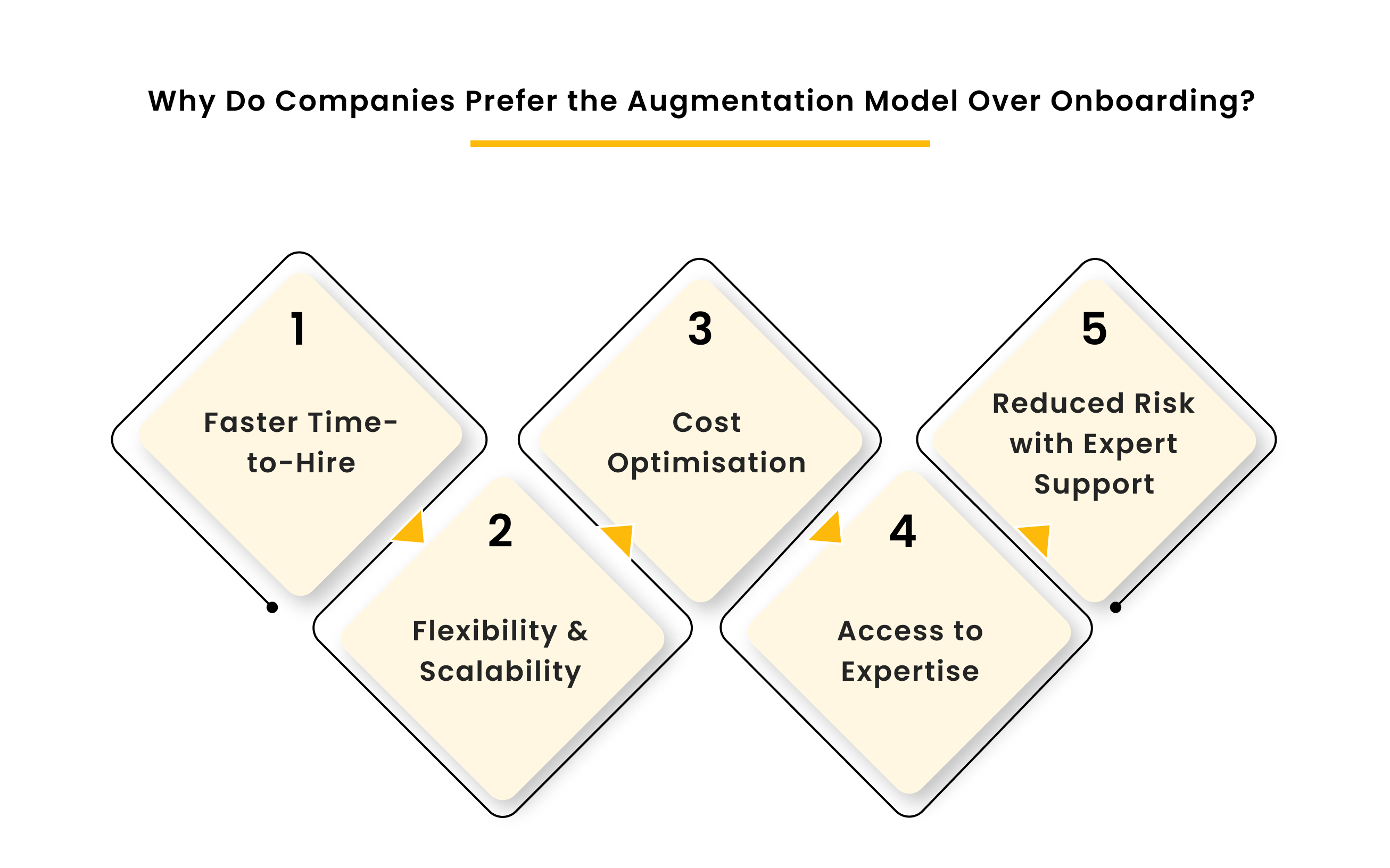
Here are the key benefits for which organizations increasingly prefer augmentation over traditional onboarding:
1. Faster Time-to-Hire
Traditional recruitment cycles can take weeks or even months, which slows down critical initiatives. This model allows companies to fill skill gaps within days and complete projects without any delay. With immediate access to qualified engineers and domain experts, organizations can accelerate execution and meet demanding timelines.
2. Flexibility & Scalability
Project needs often fluctuate, which demands rapid adjustments in team size. On-demand staffing enables organisations to scale resources up or down seamlessly, whether for a six-month engagement or a short-term assignment. This model allows businesses to downsize smoothly once projects are completed, unlike permanent hiring, which can make reductions costly. In traditional hirings, companies have to cover severance, benefits, and compliance risks when letting full-time staff go. It can also damage an employer's reputation and disrupt operations, adding hidden expenses.
3. Cost Optimization & Reduced Recruitment Overheads
The model ensures costs remain aligned with actual needs. Organizations pay only for the expertise required, while overhead expenses such as benefits, training, office space, and equipment are minimized. Many providers also manage payroll, HR, and compliance responsibilities, further lowering administrative costs and risks. Almost 70% of companies now rely on staff augmentation mainly because it offers immediate cost savings compared to traditional hiring.
4. Access to Specialized Expertise
As technology rapidly evolves, securing talent with advanced skills such as AI, cloud computing, or cybersecurity can be challenging. External workforce support provides access to a broader global talent pool, which makes it possible to bring in highly specialized professionals who may not be available locally.
5. Reduced Risk with Expert Support
Engaging external talent on a contractual basis limits long-term liabilities while ensuring continuity. This approach enables in-house teams to focus on core strategic initiatives, while external experts handle tactical execution. Since augmented professionals arrive with proven skills, training requirements are minimal, leading to faster productivity gains.
Key Scenarios Where Staff Augmentation Delivers Value
Although the augmentation model appears appealing, it is not always the right approach. Nonetheless, there are specific situations where businesses require external staff to handle various operations.
When cost reduction is a priority
Hiring full-time staff means carrying the weight of salaries, benefits, training, and long-term commitment, even when demand fluctuates. This is where augmentation eliminates heavy costs. External talent joins only when needed, and keeps budgets lean while still delivering expertise. This approach frees resources for growth, innovation, and strategic investment instead of being locked into overhead.
Through flexible models, GICOH provides specialists for short bursts (MVP sprints, AI model development, mobile app features) or long-term ongoing support (managed IT, system integration)
When teams need to scale fast
Opportunities rarely wait for hiring cycles. A sudden project, a new client, or an unexpected workload spike can push internal teams to the limit. This model provides the speed to act immediately. With instant access to skilled professionals, organizations expand capacity overnight.
When workloads slow down
Business doesn't always move in one direction. After periods of growth, workloads may dip, leaving full-time staff underutilized. With the help of on-demand talent, businesses keep teams flexible, making it easy to scale down without painful layoffs or wasted resources.
When project visibility is essential
Losing control of a project can be costly. Flexible staffing avoids this by embedding external professionals directly into existing teams, tools, and processes. Progress stays transparent, communication stays clear, and leadership keeps complete oversight from start to finish. The result: smoother collaboration, faster problem-solving, and complete confidence that goals are on track.
When specialized expertise is missing
Some projects demand niche expertise skills that are rare, expensive, or unavailable internally. Searching for permanent hires wastes time and resources. With augmentation, businesses are open to immediate specialized talent. This approach fills gaps quickly, ensuring projects move forward without costly delays or compromises in quality.
When control must stay in-house
Handing an entire project to an outside vendor often means giving up influence over decisions, strategy, and even intellectual property. The augmentation approach offers a better path. External professionals join the team but remain under the organization’s direction.
Different Staff Augmentation Models
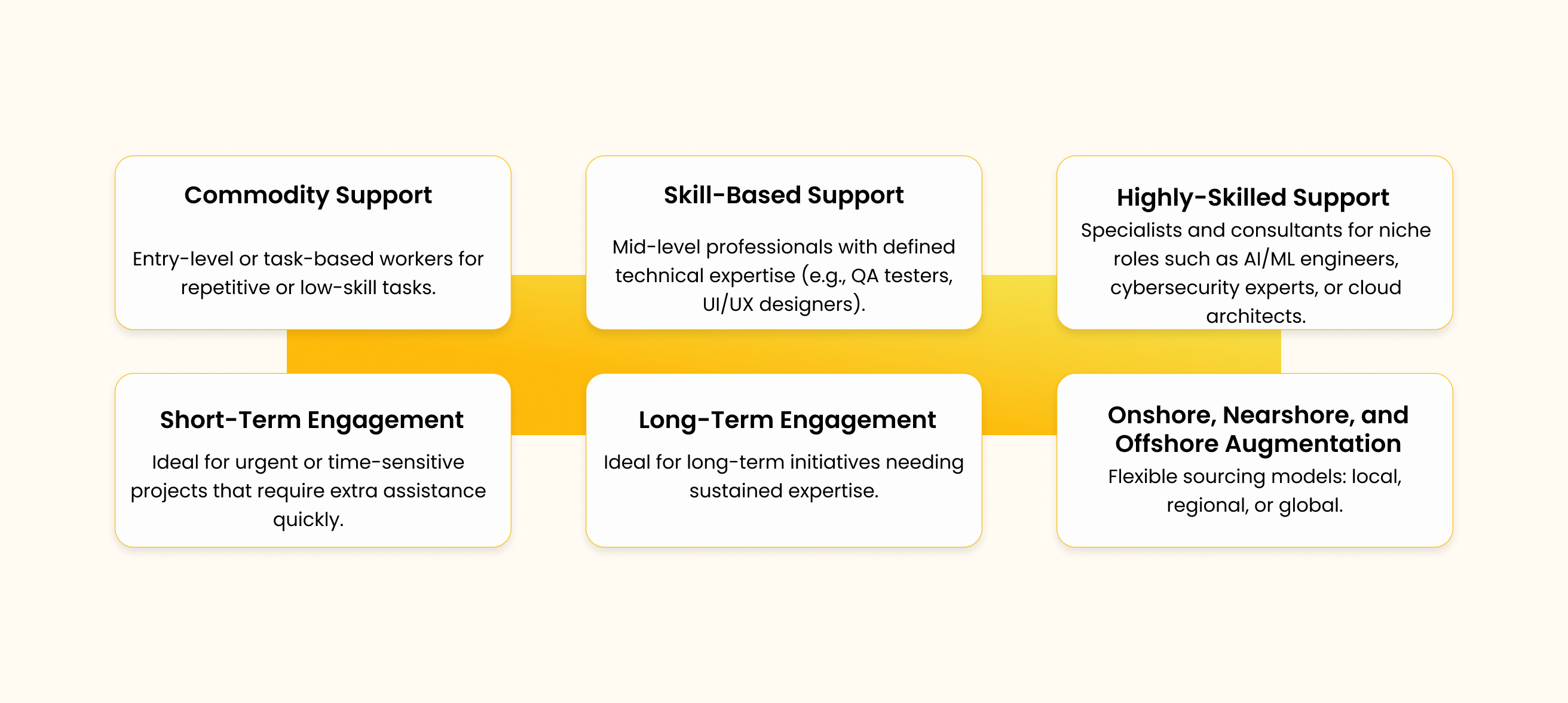
Organizations can expand their teams in several ways depending on project demands and skill requirements. Below are the most common approaches:
Commodity Support
This type focuses on roles that require minimal specialization and are usually task-oriented. It is ideal for organizations that need additional manpower to handle basic workloads such as data entry, clerical tasks, or simple administrative support. The primary advantage is speed and affordability, as resources can be brought in quickly to handle repetitive, high-volume tasks without the need for advanced training.
For example, GICOH supports foundational tasks tied to IT workflows and operations through managed services.
Skill-Based Support
Skill-based augmentation provides professionals with a defined set of mid-level skills to address specific business needs. These individuals often include IT support staff, customer service representatives, or graphic designers who bring practical expertise in their respective areas. This approach is best suited when projects demand particular skills but not deep specialization. It enables businesses to fill temporary gaps in capabilities without committing to long-term employment.
For example, GICOH provided support across UI/UX, QA, mobile testing, and product design which is ideal for short-term needs.
Highly-Skilled Support
At the top end of the spectrum, highly skilled augmentation delivers access to experts with advanced, niche, or technical knowledge. These professionals are often consultants or specialists in fields such as artificial intelligence, cloud architecture, ERP systems, or cybersecurity. They are brought in to address complex challenges, guide digital transformations, or deliver specialized outcomes that in-house teams may not be equipped to handle. This model provides strategic value by bridging critical talent gaps.
Many companies also use highly skilled augmentation to support complex technology projects such as MVP development, product development, AI/ML solutions, mobile app creation, or enterprise integrations. Providers like GICOH supply seasoned specialists who can join ongoing projects immediately and contribute advanced expertise without long-term commitments. Our team offers high-level specialists in product architecture, AI/ML engineering, cloud,mobile development, and enterprise integration.
Short-Term Engagement
Short-term augmentation addresses immediate project needs for a limited duration. For example, an organization may require extra developers during a product release cycle or testers during a critical sprint. These professionals join the team quickly, help meet aggressive deadlines, and leave once the task is complete. This type of augmentation is particularly useful for managing workload spikes without overburdening the core team.
GICOH’s developers join teams within days to support MVP launches, mobile features, or AI experiments.
Long-Term Engagement
In contrast, long-term augmentation is designed for projects or initiatives that extend over months or even years. Professionals hired under this model integrate closely with in-house teams, working almost like permanent staff but without the associated long-term obligations. This approach is common in industries such as software development, where ongoing support, product scaling, or multi-phase implementations require sustained external expertise.
At GICOH, we provide long-term teams for managed IT, system integration, and extended product development.
Onshore, Nearshore, and Offshore Augmentation
Geographic models of augmentation, onshore, nearshore, and offshore, determine where external professionals are sourced.
Onshore augmentation involves hiring talent within the same country, ensuring seamless communication and cultural alignment, though often at a higher cost.
Nearshore augmentation taps into talent from neighboring or nearby countries with similar time zones, offering a balance between cost savings and easy collaboration.
Offshore augmentation involves professionals from distant countries, often at significantly lower costs, but may introduce challenges related to time zones, language, and culture. Choosing between these options depends on a company’s priorities around budget, communication, and project complexity.
Augmentation Vs Outsourcing
Augmentation brings in external talent to strengthen your in-house team. These professionals work under your management, follow your processes, and integrate seamlessly with your internal staff.
Outsourcing, on the other hand, means handing over a complete project or function to an external company. The vendor takes full responsibility for management, delivery, and quality of the work.
Aspect | Staff Augmentation | Outsourcing |
|---|---|---|
Control | In-house | Vendor |
Integration | Seamless | Separate |
Management | Internal | External |
Responsibility | Shared | Full |
Flexibility | High | Low |
Why GICOH is the Ideal Staff Augmentation Partner
Businesses choose GICOH when they need more than just temporary manpower. We offer highly skilled professionals for MVP development, product builds, AI/ML engineering, mobile app development, managed IT services, and system integration projects. Whether you need short-term sprint support or long-term dedicated specialists, GICOH offers the talent and technical expertise to strengthen in-house teams and accelerate delivery.
Whether you’re building an MVP, scaling a product, developing AI solutions, launching a mobile app, or running long-term IT operations, we provide the right specialists exactly when you need them.