
Table of Contents
- Artificial Intelligence (AI) and Machine Learning(ML)? - A Brief Overview
- What are the Key Areas Where AI and ML Transform Business Operations?
- Customer Experience
- Decision-Making
- Operations and Supply Chain
- Sales and Marketing
- Risk Management and Security
- Innovation and Growth
- Where Do AI and ML Add the Most Value for Different Businesses?
- Why Future-Proofing of Businesses Matters the Most?
- Some Future AI/ML Trends Businesses Must Watch to Stay Ahead
- Which Industries Are Seeing the Biggest AI/ML Transformations?
- How to Get Started with AI and ML for Your Business
- Assess Your Readiness.
- Start with Pilots
- Invest in Data Infrastructure
- Choose the Right Partner
- Scale Gradually
- Upskill Your Team
- Manage Change Actively
- How GICOH Can Help You Maximize Growth with AI/ML Developments?
Artificial Intelligence (AI) and Machine Learning (ML) play a role not only in enhancing business efficiencies today but also in laying the foundation for sustainable growth and long-term success.
These intelligent systems are transforming how companies understand data, streamline operations, predict demand, and make smarter decisions. Beyond these immediate benefits, AI and ML developments lay the foundation for sustainable success in the long run.
This scale of impact shows why future-proofing with AI and ML is no longer optional but a necessity. Businesses that adopt AI and ML today can position themselves to adapt faster, serve customers better, and unlock new growth opportunities.
Artificial Intelligence (AI) and Machine Learning(ML)? - A Brief Overview
Artificial Intelligence (AI) refers to technology that enables machines to perform tasks that typically require human intelligence, such as data analysis, problem-solving, and decision-making.
Machine Learning (ML), a branch of AI, allows systems to learn from data patterns and improve outcomes over time without manual intervention.
While AI represents the broader concept of creating intelligent systems, ML provides the techniques that make this intelligence possible. Together, they allow businesses to automate processes, analyze vast amounts of information, and uncover insights that drive more innovative strategies and long-term growth.
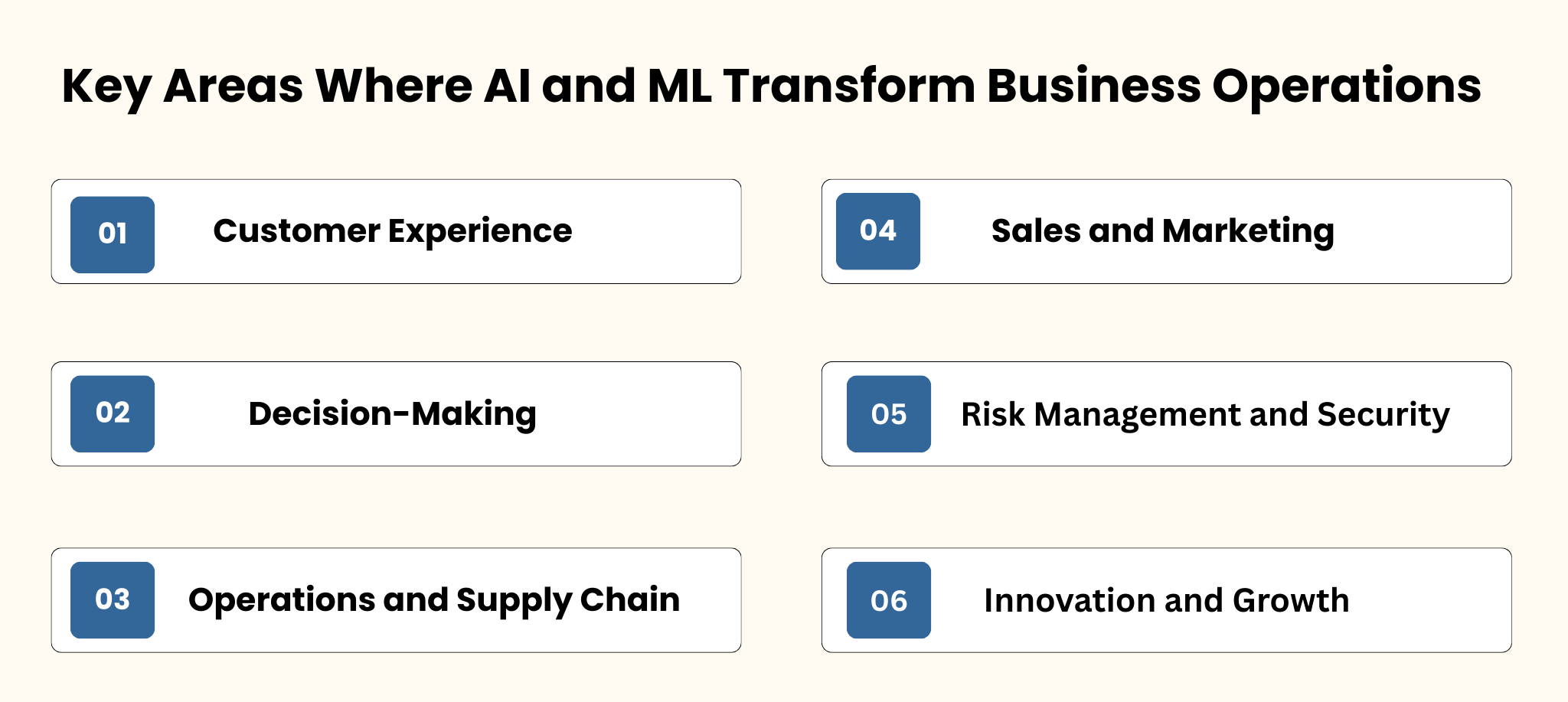
What are the Key Areas Where AI and ML Transform Business Operations?
AI and ML developments are already reshaping how businesses operate every day. AI automates time-consuming tasks, while ML continuously improves systems by learning from data patterns, improving accuracy, and making outcomes more reliable over time.. Together, they empower businesses to predict change, adjust strategies with speed, and create new pathways for growth and competitiveness.
Here are the key areas where AI and ML are driving the most impact:
Customer Experience
One of the first and most visible areas where AI and ML are making a difference is customer experience. Personalized recommendations, chatbots, and sentiment analysis make customer interactions more innovative and more engaging. In the real world, numerous companies have adopted automation to streamline their operations and improve their customer journey.
For example, Unilever uses AI to analyze customer feedback across markets and improve product messaging, while Netflix tailors viewing recommendations, with over 80% of the content watched driven by its AI-powered system.
Decision-Making
Strong decision-making depends on timely and accurate insights. Traditionally, leaders relied on manual reports or intuition, which often left room for errors or delays. AI-driven analytics change this by processing vast amounts of structured and unstructured data in real time. These systems not only identify patterns but also forecast outcomes, which enable businesses to act with greater confidence and speed. From strategic planning to everyday operational choices, AI provides clarity that drives measurable impact.
For example, Coca-Cola applies AI&ML to track consumer preferences and design new flavours, such as Cherry Sprite, based on analysis of social media conversations. This allows the company to align product development with emerging consumer tastes instead of relying only on traditional surveys or past sales data.
Operations and Supply Chain
Efficient operations and resilient supply chains are the backbone of any successful business. Yet, they are also among the most complex areas to manage due to variables like fluctuating demand, rising costs, and unexpected disruptions. AI and ML bring intelligence into these processes by enabling predictive maintenance, real-time demand forecasting, and optimized delivery routes. These capabilities reduce downtime, cut costs, and ensure that products reach customers faster and with greater reliability.
For instance, Procter & Gamble (P&G) benefits from AI to predict demand and optimize inventory across its global supply chains. It overcomes the risks of stockouts and excess inventory to keep supply and demand in perfect balance. Similarly, UPS saves millions every year using AI-driven route optimization, which reduces fuel consumption and improves delivery efficiency.
Sales and Marketing
Reaching the right audience at the right time has always been the cornerstone of effective sales and marketing. However, shifting consumer behaviours and the overwhelming volume of data make this task increasingly complex.
AI and ML simplify the challenge by enabling intelligent segmentation, campaign optimization, and personalized outreach. These tools allow businesses to understand consumer needs better, refine targeting strategies, and maximize return on marketing spend.
For example, many FMCGs are using AI to analyze digital campaigns and understand consumer behaviour, leading to higher engagement and better-targeted promotions. Similarly, Amazon takes advantage of AI-powered recommendations, which drive a significant share of its overall sales.
Risk Management and Security
Nowadays, businesses face rapidly evolving risks, such as cyber threats, financial fraud, and strict regulations. These challenges demand faster and smarter responses than traditional security systems can provide. Many of those systems struggle to match the speed and complexity of modern threats, leaving organizations exposed.
This is where Artificial Intelligence and Machine Learning step in and help organizations stay ahead of risks. They detect problems in real time, analyze large volumes of data, and stop issues before they escalate. By shifting from a reactive stance to a proactive one, AI and ML not only safeguard assets but also build customer trust and protect brand reputation.
A strong example comes from Mastercard, which applies AI to analyze transactions in milliseconds. This approach prevents fraudulent activities before they occur and ensures secure payment experiences for millions of customers worldwide.
Innovation and Growth
Sustained growth depends on continuous innovation, and AI and ML are powerful enablers of this process. These technologies go beyond automation by revealing new insights and opportunities that traditional methods often miss. They highlight patterns in consumer behavior, market trends, and product performance that guide businesses toward more innovative product development and new revenue streams.
In addition, AI and ML speed up testing and refinement, which reduces the time it takes to launch new ideas and keeps companies responsive to market shifts. This ability to innovate faster and with greater accuracy gives businesses a clear competitive edge.
The following are some real-world examples that prove the impact of AI and ML in innovation and growth:
PepsiCo uses AI to anticipate food trends and design new snack flavours that meet changing consumer preferences.
Tesla, on the other hand, applies AI to self-driving technology, using real-world data to improve performance and maintain its leadership in the automotive industry.
Together, these areas show why AI and ML are not just tools for efficiency but strategic assets for long-term resilience. They help businesses deliver superior customer experiences, make smarter decisions, run leaner operations, and build stronger defences against risks. At the same time, they fuel constant innovation and open the door to new revenue opportunities.
This combination of adaptability, reliability, and growth potential is what makes AI and ML essential for future-proofing. Companies that embrace these technologies today prepare themselves not just to survive change but to lead in the markets of tomorrow.
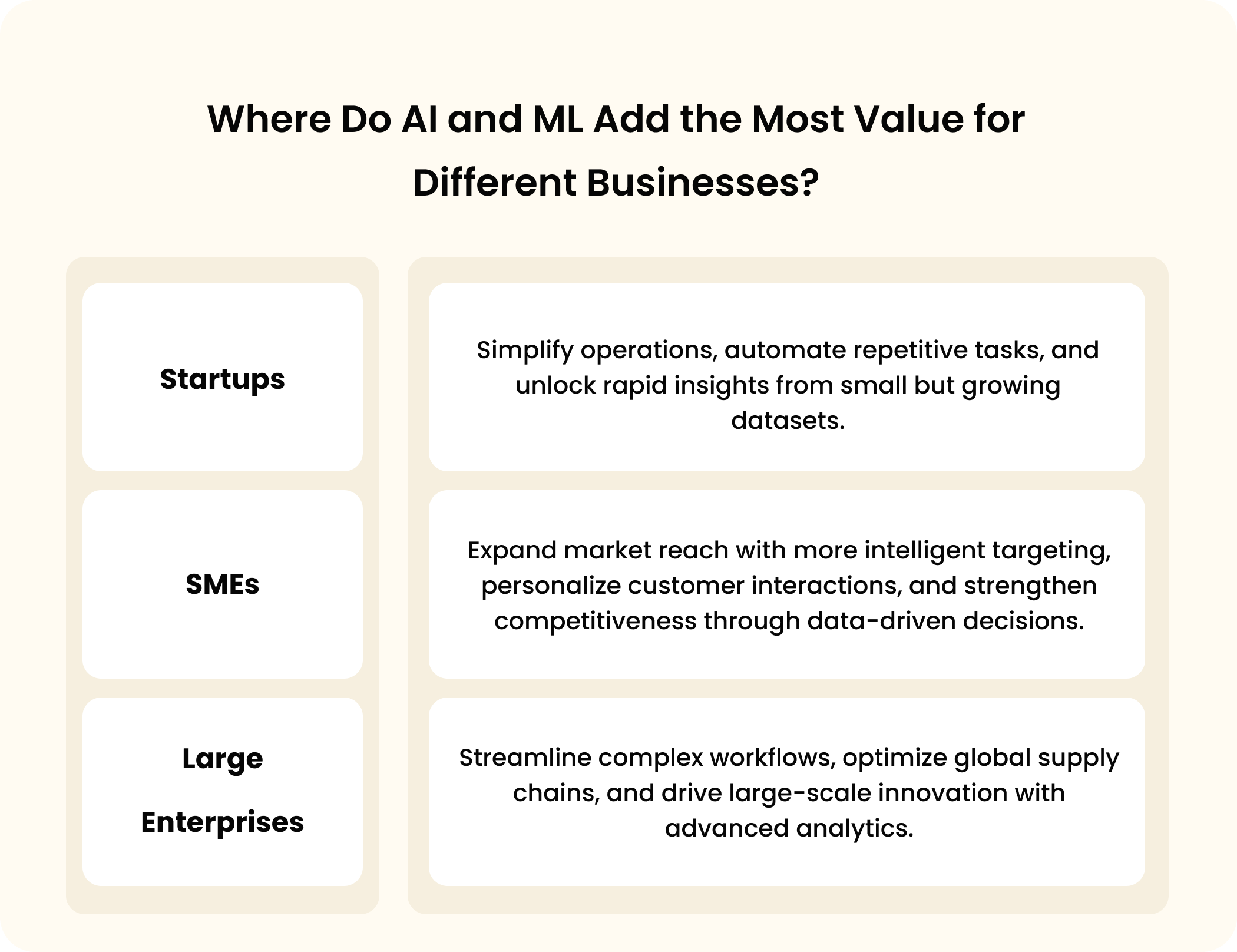
Where Do AI and ML Add the Most Value for Different Businesses?
Why Future-Proofing of Businesses Matters the Most?
Markets are shifting faster than ever. Consumer behaviour in retail and FMCG is unpredictable, logistics networks face constant disruptions, and manufacturers are under pressure to optimize costs while maintaining quality.
In this environment, companies that ignore AI risk become slow, inefficient, and disconnected from their customers. Competitors are already adopting AI-powered tools to gain speed, precision, and market insights.
Without AI and ML, companies risk becoming slow, inefficient, and misaligned with customer demand. But future-readiness with these technologies changes the equation. AI-driven forecasting ensures FMCG brands never run into stockouts, logistics firms respond instantly to route changes, retailers personalize customer experiences in real time, and manufacturers streamline production to minimize waste
More importantly, future-proofing is not only about survival. It is about building long-term strength. When your systems learn from data, your business reacts quicker than the competition and operates with greater accuracy. That advantage drives customer loyalty, reduces waste, and creates room for new revenue streams.
In short, businesses that embrace AI and ML today set the foundation for sustainable success tomorrow.
Some Future AI/ML Trends Businesses Must Watch to Stay Ahead
AI and ML are already delivering results, but the next wave of innovation will reshape how businesses operate even more profoundly. To stay future-proof, leaders must keep an eye on upcoming developments that promise both opportunity and disruption.
Generative AI – Tools like ChatGPT and DALL·E have shown how generative models can create text, images, and even product designs. For businesses, this means faster content creation, automated reporting, and accelerated product prototyping.
AI Agents – Unlike static models, AI agents can act autonomously, perform multi-step tasks, and adapt to dynamic conditions. This opens doors for intelligent virtual assistants in customer service, logistics, and operations.
Edge AI – By running AI models directly on devices and local servers, edge AI reduces latency and enhances data security. This is critical for industries like manufacturing, retail, and healthcare, where real-time responses are vital.
Federated Learning – Instead of centralizing sensitive data, federated learning allows AI models to train across multiple sources while preserving privacy. This trend is gaining traction in financial services and healthcare.
Explainable AI (XAI) – As regulations tighten, businesses will need AI systems that not only predict outcomes but also explain their reasoning. Transparency will be key for compliance and trust.
Human-AI Collaboration – The future is not about replacing people but about empowering them. Businesses will increasingly see AI as a teammate that supports decision-making and innovation.
These trends show that AI is not standing still. Companies that prepare now will be ready to utilize these advancements, while late adopters will find the gap even harder to close.
Which Industries Are Seeing the Biggest AI/ML Transformations?
AI and ML adoption are not limited to one field. They are reshaping entire industries. From improving efficiency to unlocking new services, their practical applications are becoming essential. Here are some major industries where AI and ML are bringing real transformation:
How to Get Started with AI and ML for Your Business
Transitioning from vision to execution requires a clear roadmap. Many businesses hesitate because AI feels complex, but the path to adoption can be divided into manageable steps.
Assess Your Readiness.
Begin by identifying where AI can add the most value. This could be in customer service, supply chain, or risk management. Identify and map current gaps in data, technology, and processes.
Start with Pilots
Launch small projects that solve specific problems, such as demand forecasting or fraud detection. Quick wins build confidence and stakeholder support.
Invest in Data Infrastructure
High-quality, accessible data is the foundation of practical AI. Without it, models cannot deliver accurate insights.
Choose the Right Partner
Collaborate with AI/ML development service providers who bring proven expertise and scalable solutions. This helps overcome talent and technology shortages.
Scale Gradually
Expand successful pilots across functions, embedding AI into everyday workflows instead of treating it as a side project.
Upskill Your Team
Equip employees with training to work alongside AI systems. Human expertise remains essential in interpreting insights and ensuring ethical use.
Manage Change Actively
Address resistance by showing tangible benefits, celebrating small successes, and fostering a culture of innovation.
The journey is not about adopting AI overnight. It is about building a foundation that future-proofs your business to grow smarter with every step.
How GICOH Can Help You Maximize Growth with AI/ML Developments?
AI and ML are no longer optional, but they are strategic enablers of growth, resilience, and innovation. Companies that embrace these technologies today position themselves to adapt faster, serve customers better, and stay competitive in a rapidly evolving world. The future belongs to businesses that prepare now.
At GICOH, we specialize in building AI/ML solutions tailored to your business goals, whether it’s more intelligent decision-making, supply chain optimization, or customer personalization. Our team helps you turn complexity into clarity, unlocking new growth opportunities with future-ready systems.